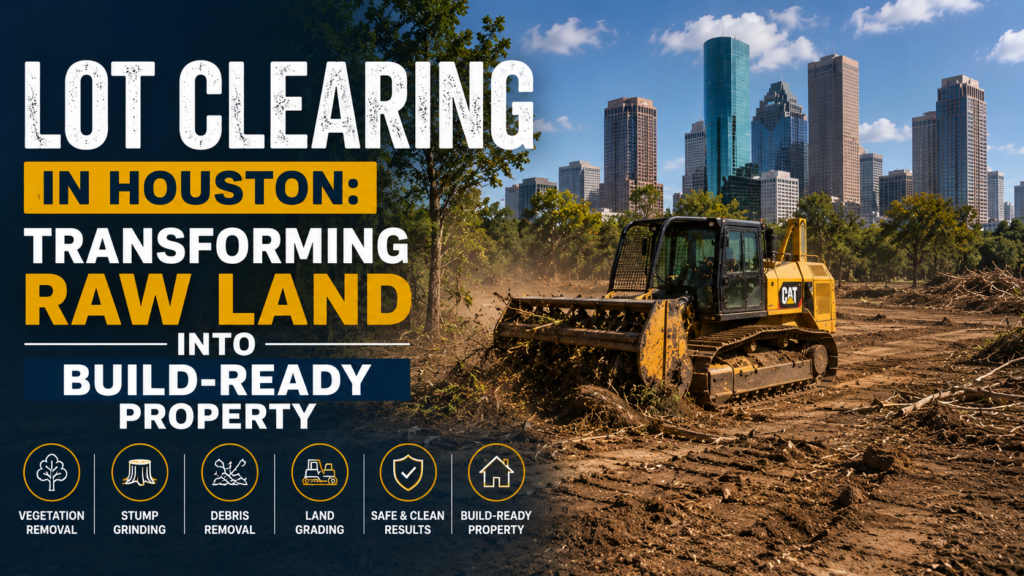
Houston’s land market is active at every level from multi-acre commercial parcels on the urban periphery to individual residential lots deep inside the Loop. For property owners at any of these scales, the path from raw or overgrown land to usable, build-ready property runs directly through lot clearing. This process is both more involved and more important than many first-time landowners expect.
Understanding what Lot Clearing Houston encompasses, why it matters specifically in Houston’s context, and what happens during a professional clearing operation helps property owners approach their land with realistic expectations.
What Lot Clearing Means
Lot clearing is the removal of vegetation, debris, stumps, and surface obstacles from a property in preparation for construction, landscaping, agricultural use, or simply to improve the land’s appearance and accessibility. Unlike large-scale site clearing for major commercial development which may involve heavy earthworks, mass grading, and complex environmental management lot clearing is typically associated with individual parcels that need to be prepared for a specific next use.
In Houston and the surrounding suburban communities of Harris, Fort Bend, Montgomery, and Brazoria counties, lot clearing is commonly needed before building a new home on a raw parcel, before expanding an existing structure, to improve property appearance for sale or lease, to reduce fire risk in heavily vegetated properties, to eliminate pest habitats created by dense overgrowth, and to simply make land accessible for outdoor use or agricultural purposes.
What Gets Cleared During a Lot Clearing Project
The scope of any lot clearing project depends on what currently occupies the land. In heavily wooded lots common in the Piney Woods regions to the north and northeast of Houston clearing involves felling trees, removing brush and undergrowth, grinding or extracting stumps, and managing all of the resulting debris.
In the greater Houston metro area, invasive species like Chinese Tallow trees and Chinese Privet are widespread problems. These fast-growing invasive plants colonize available land rapidly, outcompeting native species and quickly turning open areas into dense vegetation. Effective lot clearing identifies and removes these invasive species along with their root systems, preventing rapid regrowth after clearing is complete.
Even on lots that appear relatively clear at first glance, a thorough clearing operation may uncover old debris piles, buried concrete or masonry from previous structures, underground stumps from trees felled years earlier, and other hidden obstacles that would create problems if left in place during construction.
Lot Clearing Methods
The appropriate clearing method for any given Houston lot depends on the vegetation density, lot size, proximity to neighboring structures, planned end use, and the property owner’s preferences regarding what happens to cleared material.
Forestry mulching has become increasingly popular for residential lot clearing in the Houston area, particularly for large wooded parcels. Dedicated forestry mulchers are high-horsepower machines built specifically for this purpose. They cut through trees, brush, and stumps simultaneously, grinding everything into a layer of organic mulch that remains on site. This eliminates the need for large burn piles or multiple haul-off trips, accelerating the timeline significantly. A well-mulched parcel can be ready for use essentially the day the equipment leaves. However, for lots where a concrete slab foundation will be poured, stumps and root systems within the building footprint must be fully extracted rather than mulched in place, as organic material cannot remain below a foundation.
Traditional clearing using bulldozers and excavators pushes trees and vegetation over and removes them from the lot. This approach can clear large areas quickly and is well-suited to parcels where getting to bare soil is the primary objective. It typically requires debris piling and either burning (where permitted) or haul-off of the generated material.
Selective clearing preserves certain trees or vegetation while removing others. This is common in residential lot clearing when a property owner wants to maintain heritage trees, create a park-like appearance, or retain natural buffers along property lines while opening up the central area for construction or use. Selective clearing requires more operator skill and careful equipment selection to work around designated preservation trees without damaging their root systems.
Underbrushing is a lighter form of clearing that removes invasive undergrowth and low-growing vegetation without clearing trees. This is the right choice when land is not being prepared for construction but rather being improved for outdoor use, livestock grazing, or aesthetic purposes.
Why Proper Root Removal Matters
One of the most important and often underappreciated aspects of lot clearing for construction is thorough root removal. When trees are cut at ground level without addressing the root system, the roots remain in the soil. As organic material, roots eventually decompose, and that decomposition creates voids in the soil. For a structure built over those voids, the result can be differential settlement, cracking, and long-term foundation problems.
For construction applications, professional lot clearing specifically addresses root systems, either through stump grinding to several inches below grade or through full extraction using specialized equipment. This extra step adds time and cost to a clearing project but prevents significantly more expensive problems later.
Lot Clearing and Property Value in Houston
Well-maintained, cleared land is significantly more marketable than overgrown parcels in Houston’s competitive land market. Raw land investors, homebuilders, and individual buyers find it much easier to evaluate a property when they can see and access the ground, walk the boundaries, and understand the topography. An overgrown lot that resembles a jungle can deter potential buyers who are not able to visualize the property’s potential.
For homeowners in established neighborhoods, maintaining clear and managed lots contributes positively to neighborhood aesthetics and, by extension, to broader property values in the community. This extends to commercial and rental properties as well, where a well-maintained appearance signals quality and professionalism.
Fire Safety and Pest Control
In drier periods, overgrown Houston lots can become fire hazards. Dense, dry vegetation can ignite and spread rapidly, posing risks not just to the property itself but to neighboring structures and the broader community. Lot clearing reduces this risk by eliminating the fuel load that makes fires possible.
Dense vegetation also creates ideal habitat for a range of pests common in the Houston area, including rodents, snakes, and insects. Thinning or clearing overgrown lots reduces the protected habitat these pests rely on, reducing contact between wildlife and neighboring residential or commercial activity.
Permits and Environmental Considerations
Lot clearing in Houston and the surrounding municipalities may require permits depending on what is being removed and where. Many municipalities have tree protection ordinances that require permits for the removal of trees above a certain size. Floodplain regulations may restrict clearing in low-lying areas. Homeowners associations in many Houston-area communities have their own standards governing what can and cannot be removed from a lot.
Checking applicable requirements before beginning any clearing work is the responsible approach and working with a clearing contractor familiar with Houston-area regulations simplifies that process considerably.